How to Email a Professor About a Missed Deadline
How to email a professor about a missed deadline or extension, with wording and timing that actually gets a yes.
 folk team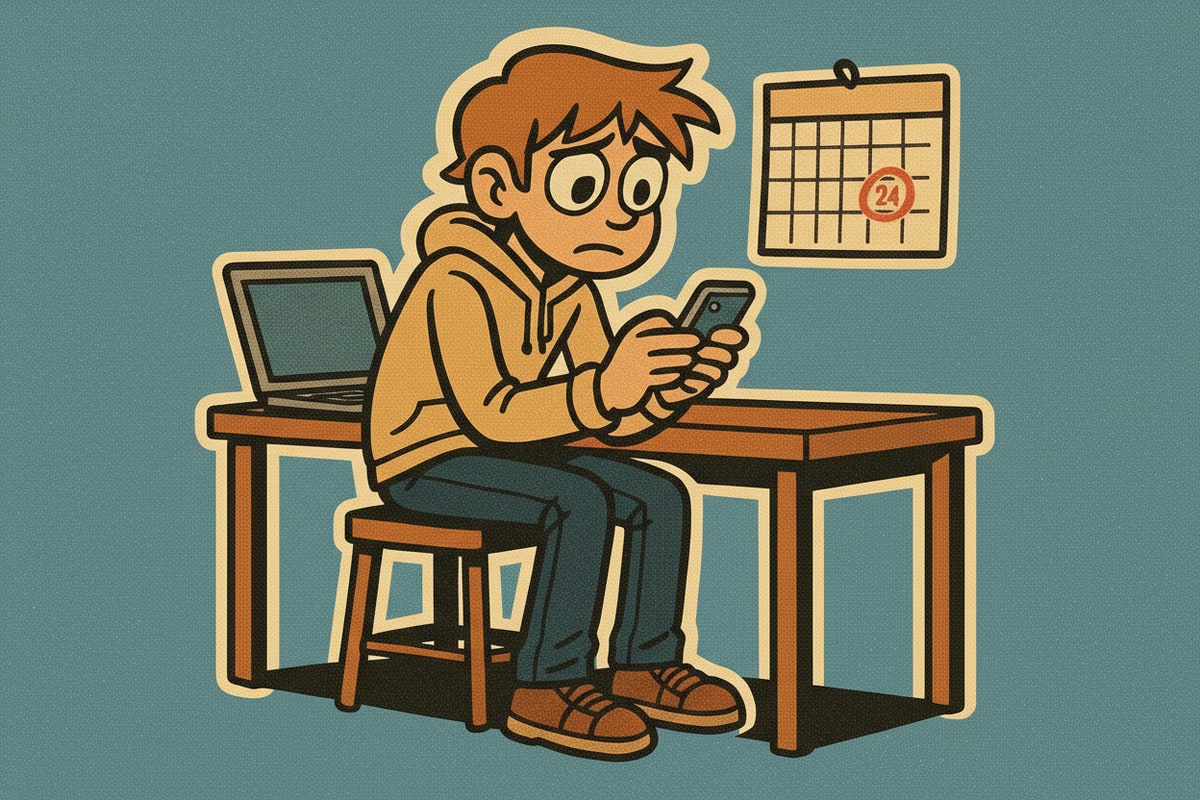
The due date passed two hours ago, or it's tomorrow morning and the paper isn't close to done. Either way, there's an email you should probably send, and you've opened a blank reply three times without writing anything, because you're not sure if this is a "quick heads up" situation or a "beg for mercy" situation.
Most of the anxiety here isn't about the assignment. It's about the email itself, how much to explain, whether to apologize, whether asking makes things worse. The actual mechanics of this message are more forgiving than they feel from the inside.
Quick answer: Email your professor before the deadline if you can, name the assignment, propose a specific new date, and give one honest sentence about why, no long explanation needed. If you've already missed it, do the same thing minus the "before" part: apologize briefly and ask what your options are. A texting AI assistant that remembers your classes and drafts the email for you can have that message ready to send in a couple of lines back and forth.
When should you email your professor about an extension?
As early as possible. If you know by Tuesday that Friday's deadline isn't happening, the email should go out Tuesday or Wednesday, not Thursday night. Central Georgia Technical College's library guidance for students puts it plainly: "it is always better to ask for extra time before your paper is due" rather than after, since asking ahead reads as planning for a problem instead of reacting to one.
This matters more than the wording of the email itself. A professor who gets a heads-up two days out can actually adjust something. A professor who gets an email an hour before the deadline, or after it, is choosing between a few narrower options: accept it late, dock it, or say no.
What should the email actually say?
Keep it short. Three parts cover almost every version of this email:
- Name the class and the assignment. "In your Tuesday/Thursday Econ 201 section, problem set 4" is faster to place than a professor guessing which of five sections you're in.
- Propose a specific new date. "Could I turn it in by Friday at 11:59pm instead of Wednesday?" is a request a professor can say yes to in one line. "Can I get some more time?" starts a back-and-forth about how much.
- Give one honest sentence about why. You don't need paragraphs. A short, real reason (a scheduling conflict, an illness, a job shift that ran long) is enough context to make the request make sense.
Central Georgia Technical College's guidance for students adds one more useful detail: keep the ask reasonable, something like 1 to 3 days in most cases, and save longer requests for genuinely major circumstances. A short ask is also an easier yes.
What if you've already missed the deadline?
Send the email anyway, and send it now rather than waiting to see if it gets noticed. The structure barely changes:
- Open with a short apology. "I'm sorry, I missed the deadline for the lab report" is enough. You don't need to over-explain in the first line.
- Ask what your options are. "Is there a way I can still submit it, even for reduced credit?" gives the professor something concrete to respond to, instead of leaving them to guess what you're asking for.
- Don't wait for a better moment. The version of this email sent the same day is almost always better received than the one sent a week later, once the assignment has clearly been graded without you.
Waiting doesn't make the conversation easier. It just moves the same email to a moment when there are fewer options left on the table.
Is it better to tell the truth than make up an excuse?
Yes, and the data on this is more one-sided than it feels in the moment. A study of 319 college students, reported by Faculty Focus, found 61 percent said they'd fabricate an excuse for a late assignment rather than tell the truth, with family emergencies, tech problems, and illness as the most common invented reasons. Only 39 percent said they'd be honest.
The strange part: how much the assignment counted toward the final grade made no measurable difference to whether a student planned to lie. People who were going to fabricate an excuse were also more confident it would work than the people planning to tell the truth, which suggests the confidence is more about the drama of the excuse than anything a professor is actually more likely to believe. A plain, low-key, honest reason doesn't need to compete with a fictional one. It just needs to be short and specific.
How folk handles this for you
folk is the personal AI assistant that lives in your texts (iMessage, Telegram, and WhatsApp, same folk and same memory across all three), and this email is a small, recurring version of the same coordination problem it handles for the rest of a student's week.
- It reminds you before the deadline, not after. Once folk knows an assignment is due, a reminder a few days ahead gives you the window to ask for more time while asking early is still an option, instead of finding out you're already late.
- It remembers your classes and professors. Tell folk once which professor teaches which class, and its memory carries that into the next email, so you're not re-explaining your own schedule every time something comes up.
- It drafts the email. Ask folk to write the request, apology, or check-in, naming the assignment and a specific new date, and it drafts it in your voice.
- You approve, it sends nothing on its own. Every draft is yours to edit or send. folk never emails a professor without you approving the message first.
- It follows up if you don't hear back. A recurring nudge checks the thread again after a couple of days, the same follow-up habit that works for any email you're waiting on a reply to.
The bottom line
This email feels bigger than it is. The version that works is short: name the assignment, propose a specific date, give one honest sentence, and send it as early as you can, or immediately if the deadline has already passed. Professors read a lot of these, and a plain, specific one is easier to say yes to than an anxious, over-explained one.
Get started with folk and tell it about your classes to get a heads-up before the next deadline, instead of after. It's the same assistant behind booking office hours without a week of back-and-forth and automating the rest of a student's week.
meet folk
The personal AI that lives in your texts - iMessage, Telegram, and WhatsApp. Free to start.